Hydraulic System Solutions for Truck-Mounted Cranes
Truck-mounted cranes are core equipment for logistics transfer, construction and field repair. Rising demands on working efficiency and safety are reshaping their hydraulic architecture. This article sets out HXLC's system-level response.
I. Industry Needs and Operational Challenges:
Mobile cranes are essential equipment in logistics and transportation, construction projects, and on-site repairs, and they are facing increasing demands for both operational efficiency and safety. Customer needs are primarily focused on:
Complex coordinated actions: Lifting, tilting, and telescoping operations often require frequent simultaneous execution. Traditional valve control systems can suffer from flow competition, leading to delayed responses and instability in these movements, which significantly impacts operational smoothness.
Extreme operating condition adaptability: In harsh environments such as mines, deserts, and cold regions, valves are susceptible to damage from dust, low temperatures, and vibrations, leading to high failure rates and significantly increased maintenance costs.
Energy consumption and efficiency are often in conflict: hydraulic systems experience significant power losses during high-flow operations, leading to high fuel costs. Conversely, energy is wasted during light load conditions.
Modular expansion requirements: Host manufacturers require rapid adaptation of models with different tonnage and control precision (manual, electro-hydraulic, proportional electric, CAN bus) to shorten development cycles.
The issues mentioned have evolved from being "acceptable" to becoming "mandatory constraints" within the industry, directly determining the market competitiveness of host products.
II. Precise Product Portfolio: From Core Valve Assemblies to System-Level Solutions
To address these challenges, we have developed a comprehensive product portfolio covering the entire flow range and all control modes, providing tailored hydraulic control solutions for truck-mounted cranes.
2.1 Basic Execution Layer — Sequencing and Balancing Control
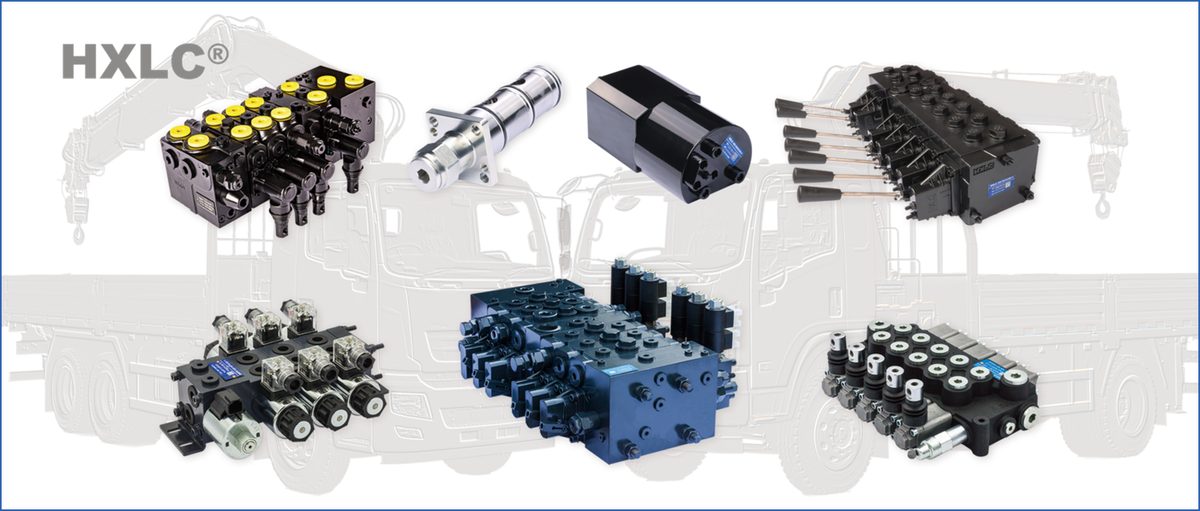
The XLXCF mechanical sequence valve, combined with the SP series counterbalance valve, is specifically designed for cylinder sequencing and load holding applications. The mechanical sequence valve ensures that multi-stage cylinders extend and retract in a pre-defined sequence, preventing impacts; the counterbalance valve provides stable back pressure support to prevent uncontrolled descent of loads, enabling smooth micro-movements and ensuring operational safety from the ground up.
2.2 Composite Action Core — Upper Control Valve System
The XLC95 series upper (superstructure) control valve utilizes post-compensation (LUDV) technology to effectively overcome flow saturation, ensuring that when the crane is operating with boom extension, rotation, and other functions simultaneously, each hydraulic actuator receives a proportional share of the flow, resulting in coordinated movement without interference. It can be optionally equipped with our self-developed dual-pump merging low-pressure relief system, which provides merged power output under high-pressure, large-flow conditions to facilitate rapid lifting; this significantly reduces engine power consumption, achieving measured overall energy savings of 15% to 20%, balancing efficiency and economy.
2.3 In-cab operation and protection against harsh environments.
The XLZA50 eight-way, five-function valve features a fully cast valve body for compact construction and reduced leakage points. It is equipped with a dual control structure; the rear control section includes a special sandproof cover that effectively prevents dust, sand, and mud from entering, making it suitable for harsh environments such as mines and deserts, significantly extending the lifespan of the valve components and reducing downtime for maintenance.
2.4 Full-flow flexible platform - Modular multi-mode valve group.
The XLPVG series utilizes pre-compensation technology and offers three flow rate options: 60 L/min, 120 L/min, and 400 L/min, covering the full range of requirements for truck cranes from small to large tonnage. Its core advantage lies in its modular design – the rear module can be flexibly configured according to specific needs.
Hydraulic control mode (economy type, suitable for simple working conditions).
Electro-hydraulic mode (offers fast response and is compatible with conventional electro-hydraulic control systems).
Electro-proportional mode (provides precise speed control to meet the requirements of precision lifting).
CAN bus module (digital communication, integrated intelligent vehicle control).
The high-flow version with a capacity of 400 L/min utilizes post-compensation technology and is specifically designed for heavy-duty truck-mounted cranes, ensuring excellent maneuverability even under extreme loads. This platform allows manufacturers to adopt a "one valve body, multiple configurations" approach, significantly reducing the development and validation cycle for new models and minimizing inventory complexity.
III. Systemic Value: From Point Improvements to Overall Efficiency
We don't just offer individual components; we provide a complete hydraulic control ecosystem that covers applications such as loading/unloading, small/medium/large flow rates, and manual/electric/intelligent control options.
Technical Synergy: The sequence valve, counterbalance valve, upper (superstructure) control valve, and lower (chassis) control valve work in coordination to achieve full-link optimization from the power source to the actuator, eliminating system matching deficiencies.
Scenario-specific solutions are provided for applications such as "high-efficiency combined actions," "low energy consumption under light loads," "robust protection," and "rapid selection," enabling customers to flexibly combine components based on different market regions (e.g., domestic infrastructure projects, overseas mining operations).
Long-term value: Reduced fuel consumption, fewer failures, and shorter development cycles ultimately translate into lower cost per tonne-kilometre for end users and faster market response times for host manufacturers.
The competition in the mobile crane market has shifted from simply "how much weight can it lift" to "can it lift stably, efficiently, quickly, and reliably." Our product portfolio is at the core of this transformation.